

Most property managers treat the move-in inspection as a defensive exercise. Document the condition, get a signature, file it, and hope it is never needed. That framing is not wrong, but it captures maybe a third of the value, and it produces inspections that are rushed, transactional and quietly adversarial.
The move-in inspection is the first substantive interaction of the tenancy. It is the moment a tenant forms a durable impression of whether this is a professionally run property, whether you will be responsive, and what standard is expected of them. Everything that happens over the following two years is easier or harder depending on how that twenty minutes goes.
What the Tenant Is Actually Learning
A tenant walking through a unit with you is forming conclusions about three questions, whether or not either of you names them.
Does this person notice things? If you point out a scuff on the baseboard and photograph it, the tenant concludes you pay attention to the property. That conclusion does substantial work later, because tenants treat closely-managed properties more carefully than they treat neglected ones.
Will this person be fair? If you document pre-existing damage carefully and say plainly that it is not their responsibility, you have demonstrated fairness at zero cost. Tenants who believe their manager is fair raise issues early instead of hiding them, and small problems raised early are cheap.
What happens when something breaks? The inspection is the natural moment to explain how maintenance requests work, what counts as an emergency, and what response time looks like. A tenant who knows the process uses it. A tenant who does not either calls you at midnight about a dripping tap or lets a leak run for three weeks.
Doing It Well
Walk it together, in person
Sending a form for the tenant to complete alone is efficient and wastes the entire opportunity. It also produces worse documentation, because tenants do not know what matters or how to describe it. The joint walkthrough is the product.
Be specific and consistent
“Kitchen — good” is useless at a hearing and useless to the tenant. Record what is there: a two-inch scratch on the left of the countertop near the sink, a chip on the lower cabinet door under the range, a stiff drawer runner. Room by room, same order every time, so nothing is skipped.
Photograph more than you think you need
Every room from two angles, every appliance including model and serial where visible, every existing defect in close-up, flooring in each room, walls and ceilings, the inside of the fridge and oven, and meter readings if applicable. Photos are free and memory is not. Timestamped photos attached to the tenancy record are the difference between a resolved move-out and a contested one.
Test the things that get disputed
Run every tap and check drainage. Flush toilets. Turn on every burner and the oven. Run the dishwasher briefly. Test every light fixture and outlet you reasonably can. Open and close every window and lock. Test smoke and carbon monoxide alarms in front of the tenant and record the date.
Doing this in front of the tenant is the point. You are demonstrating that the unit was handed over working, which forecloses the “it was like that when I moved in” conversation, and you are showing a standard of care.
Explain, do not just record
While you are walking, cover the practical things: where the water shutoff is, where the electrical panel is, how the heating system is controlled, when garbage and recycling go out, where parking is, and how to submit a maintenance request. This is the highest-retention moment of the entire tenancy for this information. Written into a welcome document afterwards, it is also the moment the document becomes something they might actually read.
Both parties sign, same day, with a copy provided
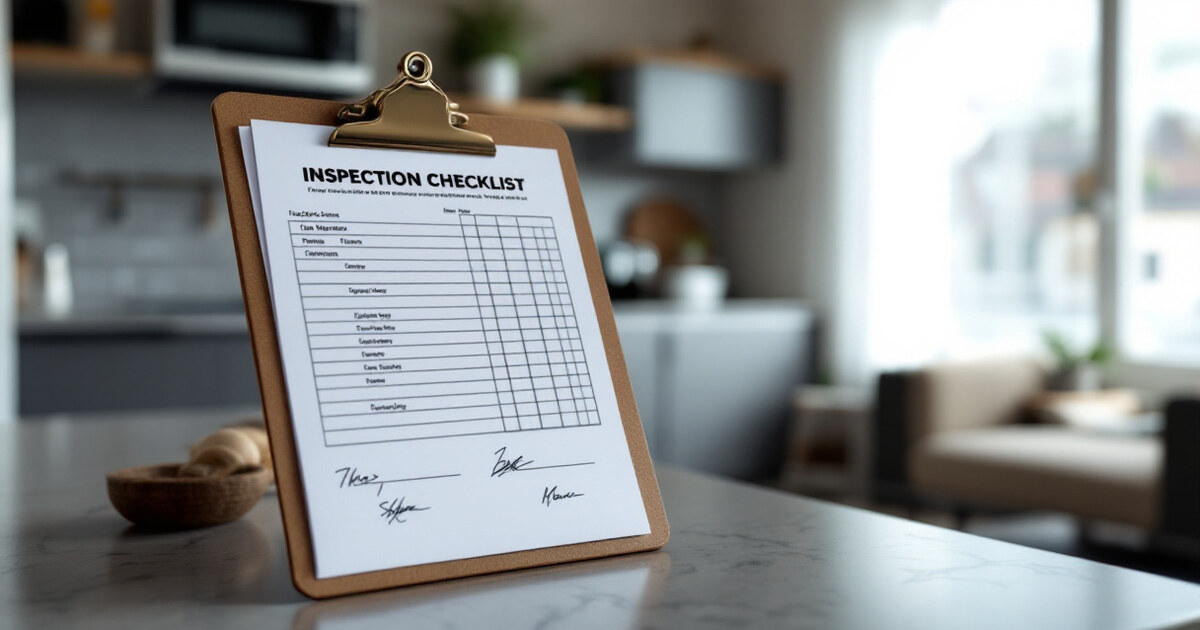
An unsigned inspection report is one party’s account. A report signed by both parties on the day, with photographs attached, is close to unassailable. Give the tenant their copy immediately, not next week, and keep proof that you did.
The Move-Out Comparison
All of this exists to make one future conversation simple. At move-out, you walk the same unit in the same order with the same form, and the comparison is factual rather than argumentative. Two photographs side by side end most disputes before they start.
It also protects the tenant, which is worth saying out loud during the move-in. A tenant who knows the pre-existing chip in the bathtub is documented does not spend the tenancy quietly worrying about it, and does not arrive at move-out feeling ambushed.
What Goes Wrong
- Rushing it. Twenty minutes is the minimum for a small unit. Booking fifteen minutes between two other appointments guarantees a thin report.
- Doing it after the tenant has moved in. Once furniture is in place, you cannot see the floor, the walls, or half the defects. The inspection has to happen while the unit is empty.
- Inconsistent thoroughness. Detailed reports for tenants you are unsure about and cursory ones for tenants you like creates exactly the pattern you do not want to have to explain, and it leaves you undocumented precisely where you assumed you were safe.
- Photos on a phone and nowhere else. A phone that is replaced, lost or wiped takes the evidence with it. Photos belong in the tenancy record, uploaded the same day.
- Treating it as a formality in front of the tenant. If your manner says this is a box to tick, the tenant learns that the property is managed by someone who ticks boxes.
Twenty Minutes, Twice
The full cost of doing this properly is twenty minutes at move-in and twenty at move-out. The return is a tenant who understood the standard from day one, a maintenance process that gets used correctly, a deposit conversation grounded in evidence, and a substantially lower chance of a tribunal hearing over a damaged countertop.
There are very few tasks in property management with that ratio. Treat it accordingly.