
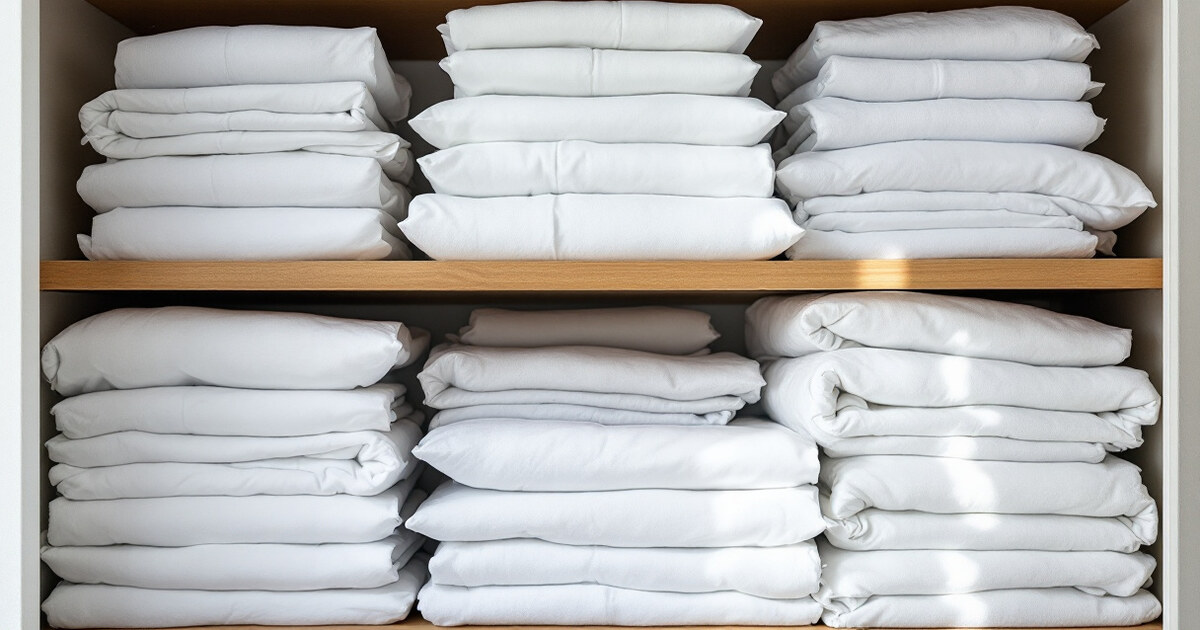
Saturday-to-Saturday rentals compress the entire changeover into a few hours between one guest leaving and the next arriving. Everything in that window is sequential, and the laundry is the part that cannot be hurried.
Washing and drying a full set of bedding and towels takes longer than the window allows if it has to happen between the two guests. So it does not happen then. It happens afterwards, which means a second set has to be on hand at changeover.
Why two sets is not enough
Two sets works until something goes wrong, and in a rental something goes wrong regularly.
A set comes off the bed stained and has to be treated or replaced. A guest departs late and the dryer cycle does not finish. A guest arrives early. The washer fails. With two sets, any one of those means the incoming guest gets a bed that is not ready, and that is the single most damaging thing that can happen to a listing's reviews.
Three sets absorbs it. One on the bed, one clean and staged in the property, one in the wash or in reserve. Nothing in the changeover window depends on a machine cycle completing.
The same logic applies to towels, and to anything else that has to be clean at arrival and cannot be replaced quickly.
Make it a checklist item, not a habit
The three-set rule fails quietly. Sets wear out, get stained beyond use, or walk off with a guest, and nobody notices the buffer has dropped to two until the week it matters.
The fix is to count at every turnover and record the count. Not an inspection someone does occasionally. A field on the turnover report, filled every time.
Recording it turns depletion into a visible trend rather than a sudden discovery. A property that has been running on two sets for a month shows up in the record, and a replacement gets purchased on a Tuesday instead of during a Saturday changeover.
What else belongs on a turnover report
The same principle covers everything the property consumes. Cleaning supplies, paper goods, coffee, batteries in the smoke detectors, propane, water filters.
Each is cheap. Each, absent at arrival, produces a guest complaint that costs far more than the item. And each is invisible until the moment it is needed, which is why counting has to be scheduled rather than triggered by noticing.
A turnover report in MapleConcierge captures structured entries alongside photographs, so the count is data rather than a note. Anything purchased to replenish becomes an extra item on the same report, with its receipt attached, and flows through to the owner's invoice at the contracted markup. The restocking and the billing for it are the same act.
The photographs are the other half
A turnover report should carry photographs of the property in its ready state. Beds made, surfaces clear, floors done.
Those images serve two purposes and both matter. They show the owner what they are paying for, which is the entire justification for a turnover fee. And when a guest reports that the property was not clean on arrival, there is a timestamped record of its condition when the caretaker left.
That second use is worth the effort by itself. Guest complaints about cleanliness are common, frequently wrong, and impossible to rebut from memory. A dated photograph settles it in one message.